Fathers Day Measured In Miles
Today is Father's Day, and to see my father I have to drive to Winnsboro.
It's a small town in South Carolina, the kind of place you'd miss if you blinked at the wrong moment, and it's where my dad started and where my dad ended, and the part in between — the part that wasn't Winnsboro — is the part I want to tell you about. I'm going to do a bad job of it. I want to say that up front. There is no arrangement of words that can hold a whole person, and a son trying to describe his father is like a person trying to describe the ocean using only a cup of its water. But I have the cup, and it's Father's Day, so here goes.
My dad grew up on what they called the Mill Hill. To hear him tell it, they weren't just poor, they were dirt poor, which I have come to understand is a distinct and specific category of poverty, the kind where the dirt is doing some of the work of describing your life. He rode his bike everywhere. He hunted. And he had a piece of advice he carried around like a pocketknife, which was that you had to watch out for those Pine Street girls.
Here is the thing about that advice. My mother lived on Pine Street.
They knew each other their whole lives, the way you know the weather or the sound of your own name. And then, somewhere in college, the thing between them caught fire. It burned so bright it outshined my dad's studies at Clemson, which is a polite way of saying my dad was failing out of Clemson because he kept hitchhiking to Winthrop to see my mom. If the weather turned or he got tired, he'd find a stranger's garage and sleep there until morning. I want you to sit with that for a second, because I think it's the most honest definition of love I know: love is the distance a young man will travel, on his thumb, in the rain, to sit beside a Pine Street girl. It was a different time. I would not be the last time he measured his love for her in miles.
When reality finally caught up to my future parents, my dad had two options. He could tell Big Stick Brigman (his father, my grandfather) that he'd flunked out. Or he could join the United States Air Force.
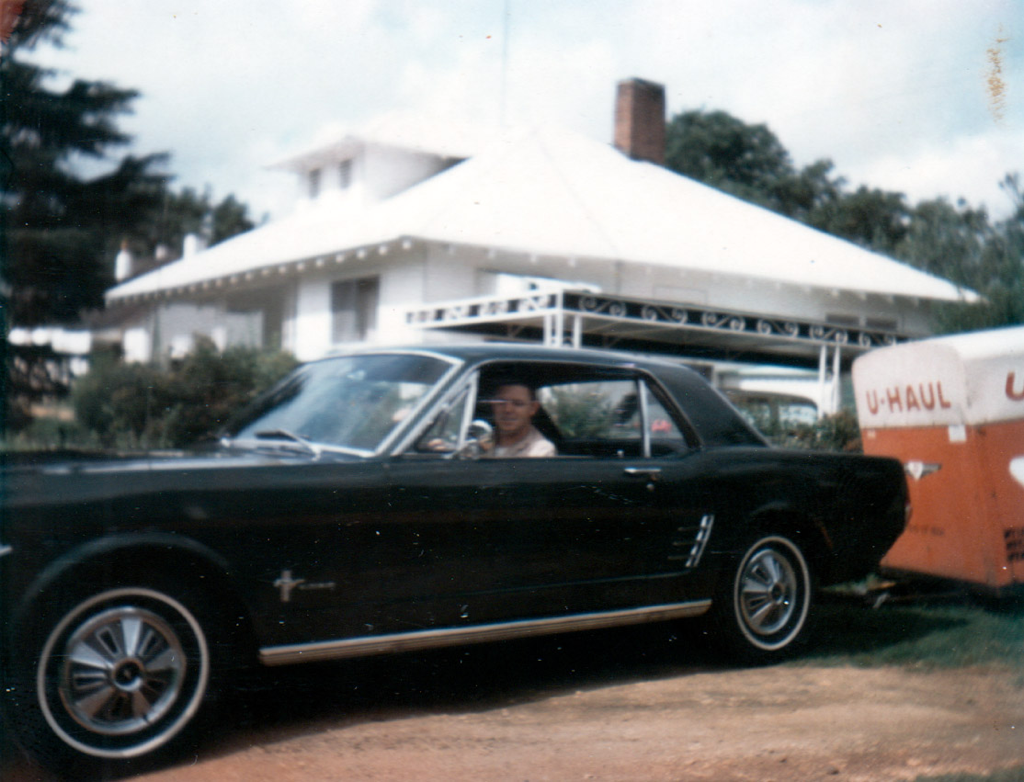
It turns out the United States Air Force was less frightening than a disappointed Big Stick Brigman. I can personally confirm the math on this. So in a brand new 1965 Ford Mustang, towing a U-Haul trailer, my dad and my mom broke camp for Washington State, which I don't think is a coincidence. I think when you've grown up under a man like Big Stick, you measure freedom in miles, and my dad wanted as many of them between himself and home as the map would allow. There's a photograph of that day, the Mustang loaded down, the orange-and-white U-Haul hitched behind it, my dad at the wheel in front of a big white house, about to drive most of the way across a country. I have looked at it more times than I can count. He doesn't know yet how the story comes out. That's the thing about photographs. Nobody in them ever does.
The Air Force, as it happens, does not especially care for headstrong young men either. This is a recurring theme in our family. But he did his time, that's another thing I'd come to share with him, and on the other side of it there was the GI Bill and a second, more dedicated chance at school. He went to Texas and got his degree in forestry, which is a beautiful thing to study, the long slow patient business of trees, and I don't think it's an accident that the man chose a science measured in decades.
But home pulls at you, soft and then hard, and eventually it pulled them back to South Carolina. Not to Winnsboro, though. To a little town called Conway. My dad worked as a forester for Canal Wood, and because one job was apparently insufficient for a man with that much to give, he also taught at Horry-Georgetown Technical College. Teaching was one of his great loves. He would teach anyone anything, if they'd only stop long enough to listen. I think that was the deal he made with the world: I will tell you everything I know, and all you have to do is hold still.
Then Canal Wood wanted to move the family to Florence, and my dad did something I've thought about my entire adult life. He gathered us up and laid out the options plainly. We could follow the job, or we could stay in Conway and try to make it work. This is one of my earliest memories, my father, treating the people he loved like people whose opinions counted.
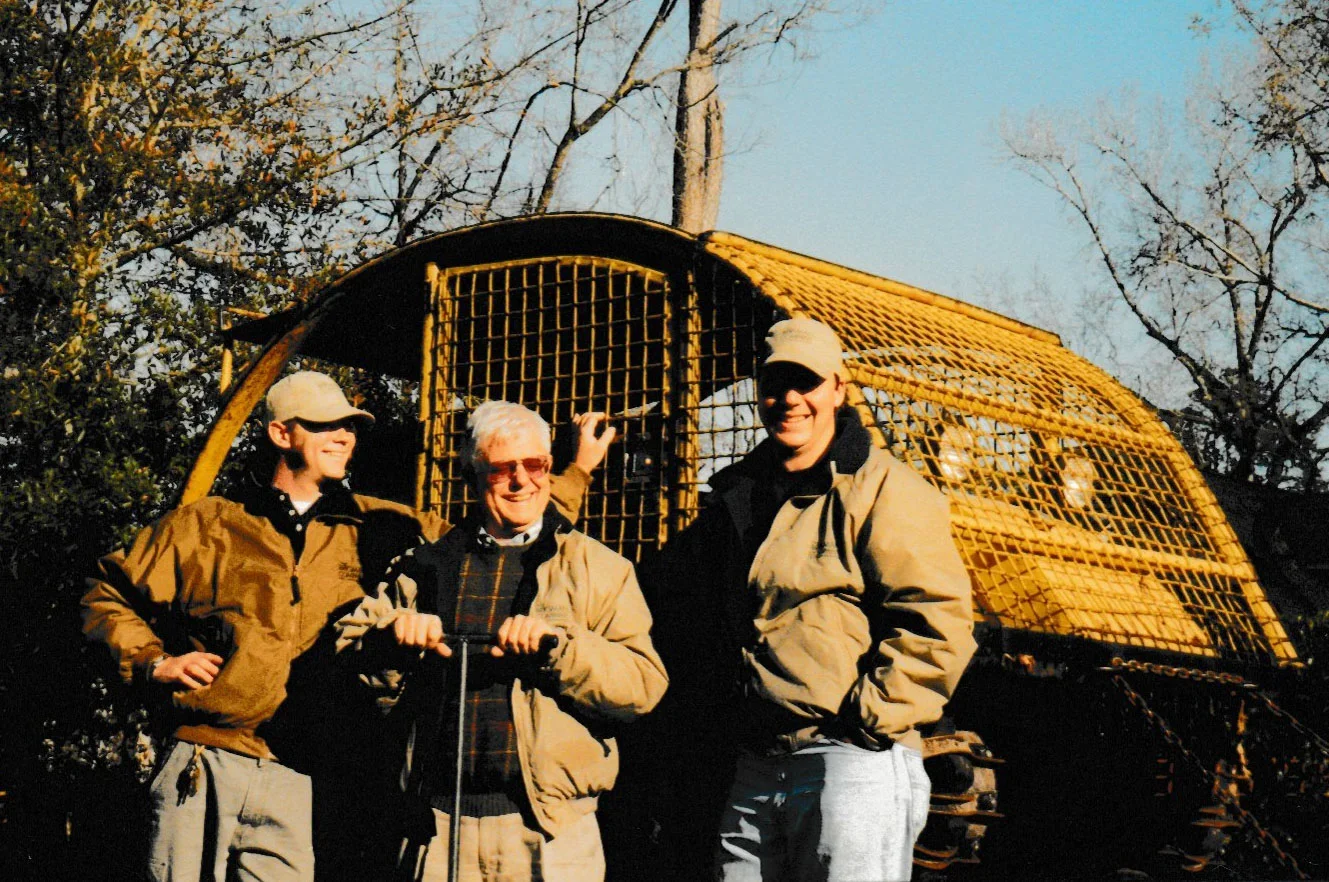
It would have been easy to follow the job. But my dad was never famous for taking the easy road, and we didn't want to go. We had a house. We had friends. We liked the small world we'd built. So my dad didn't move us. He retired from Canal Wood, started teaching full-time, and picked up a few small wetland projects on the side, and those projects had ideas of their own. They grew. They took up more and more room, the way the most important things in a life tend to do, quietly and then all at once, until in 1985 The Brigman Company was born.
In 1986 it got its first employee, Joe Floyd, and its first work truck: a black Nissan Pathfinder. That Pathfinder would go on to log well over four hundred thousand miles. It was also my first car. I love that I get to tell you that. The same truck that built my father's company also taught me to drive, that we measured both of our beginnings on the same odometer.
That's how the years went. My mom and dad had their troubles, some of them hard ones, but his dedication to her and to us never so much as flickered. Through grit and good people and a little luck, the company grew, because my dad had a gift for finding folks who were smart and honest and decent — Britt, Chuck, Jeff, and so many others — and for keeping them. And the whole time, he made sure his kids had every opportunity and were, frankly, the envy of their friends. Not many kids I knew had a dirt bike in middle school. I can promise you that.
He taught me how to work on a car. How to fish. How to shoot. How to be honest, even when it's hard — especially when it's hard, he'd say, because anybody can be honest when it costs them nothing. He taught me to stand up for myself and to watch out for the little guy. And he taught me, without ever sitting me down to teach it, to stop and watch the sun go down.
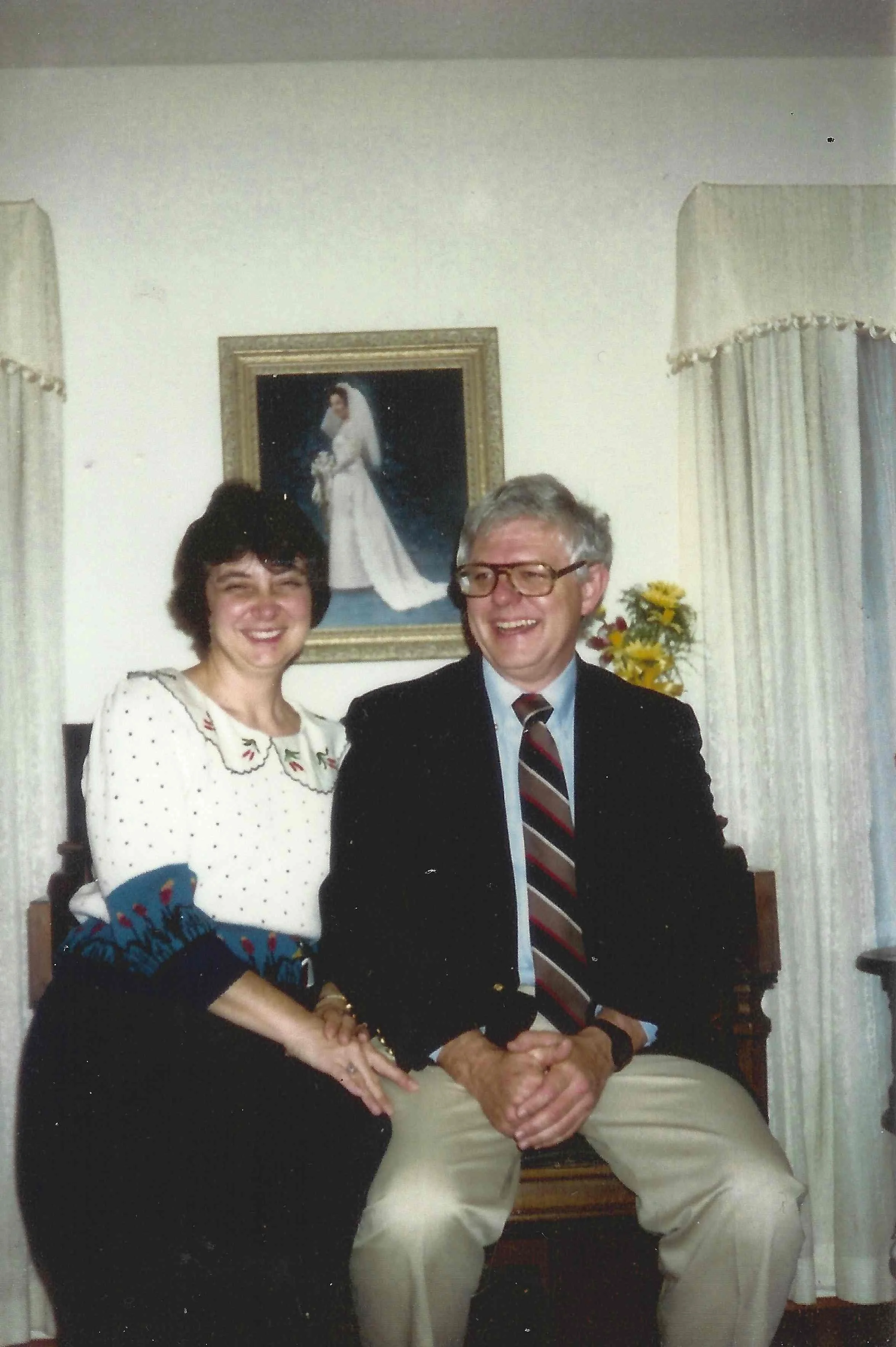
He gave me photography, too, handed down lenses the way you hand down a pocket watch. And here is the strange, aching thing about that inheritance: I don't have many photographs of my father. He was almost always on the back side of the lens, the one doing the noticing, the one making sure the rest of us were kept. The few I do have, he's usually laughing. There's one of him and my mom where they're both caught mid-laugh, her wedding portrait hanging on the wall behind them, and you can tell just from their faces that whatever the joke was, it was the kind you can only share with someone you've known your entire life. A man who spends his years behind the camera leaves behind a thin archive of his own face and an enormous one of everything he found worth keeping. I've come to think that's its own kind of self-portrait, that you can learn almost everything about a person by looking at what they pointed the lens at.
On Christmas Eve of 1996 (I think it was '96) my mom had a brain aneurysm.
That was the first time I ever saw my father cry. I'd only ever heard him cry once before, behind a closed door, when his dog Coco died. The damage to my mom was nearly total. She fell into a coma that lasted right at two years, and the doctors told us she would not wake up. We did not believe them, or maybe we just refused them. We drove to Charleston every single weekend. My dad would load us into the truck and we'd go, because that was the only thing left to do, and my dad was a man who did the thing in front of him. He became a full-time single father, ran the company, and poured whatever was left into caring for a desperately ill wife, a woman he had, by then, spent more of his life beside than his own parents. A Pine Street girl he had known and loved since before either of them knew what that love was going to cost.
And then, after all that time, she started to wake up.
It should have been the end of the hard part. Instead it was the beginning of a new fight, because the insurance company dropped her and refused to pay for the therapy that would help her come back to us. So Johnnie Brigman dug in his heels and paid for it out of his own pocket, the way he did everything, like the bill was simply his to carry. She moved to a hospital in Columbia, spent at least a year there, and got better. Well enough, eventually, to come home. That became our new normal, our new stride.
But you cannot work as hard as my father worked, and carry what he carried, for as long as he did, without it eventually coming for you.
On April 3rd, 2001, my dad and I were out at the Shelton Farm. The farm was his dream, a hundred and thirty acres in the middle of nowhere. He used to say that if you got a paper cut out there, you'd bleed to death before you reached a hospital. We were taking the bush hog off the Kubota, something we'd done a hundred times, and that small task left him lightheaded, so lightheaded that he had to sit down. When we got back to Conway he made an appointment. Monday he got checked out. Tuesday they sent us for an ultrasound. Wednesday they told us it was cancer, and it was bad.
He fought. God, he fought. Chemo twice a month. Throwing up into trash cans. Going from the strongest man I have ever known to needing my help to get to the bathroom.
I keep thinking about his hands. They were powerful hands, hands that could split a cord of wood and break a bolt rusted past all reason and then, an hour later, carve a duck decoy so intricate you'd swear it might fly. They were hands that could do anything. And the cancer took them down to hands that were weak, hands that shook with the effort of pulling a blanket up over his own chest. If you want to understand what that disease does, don't picture the big things it steals. Picture a strong man's hands losing a fight with a bedsheet.
I didn't know it at the time, but one day the doctors told him he wasn't going to win. That evening I remember him trying to give me a whole lifetime of fatherly advice in the little bit of time he had left. Trying to hand me, all at once, everything he'd meant to teach me slowly. To make the pines grow decades in minutes. It was the last time I ever saw him cry.
On July 6th 2001, I found him in his bedroom. I'm sure there were others before it, in his long life. But that was the first time I ever saw my dad lose a fight.
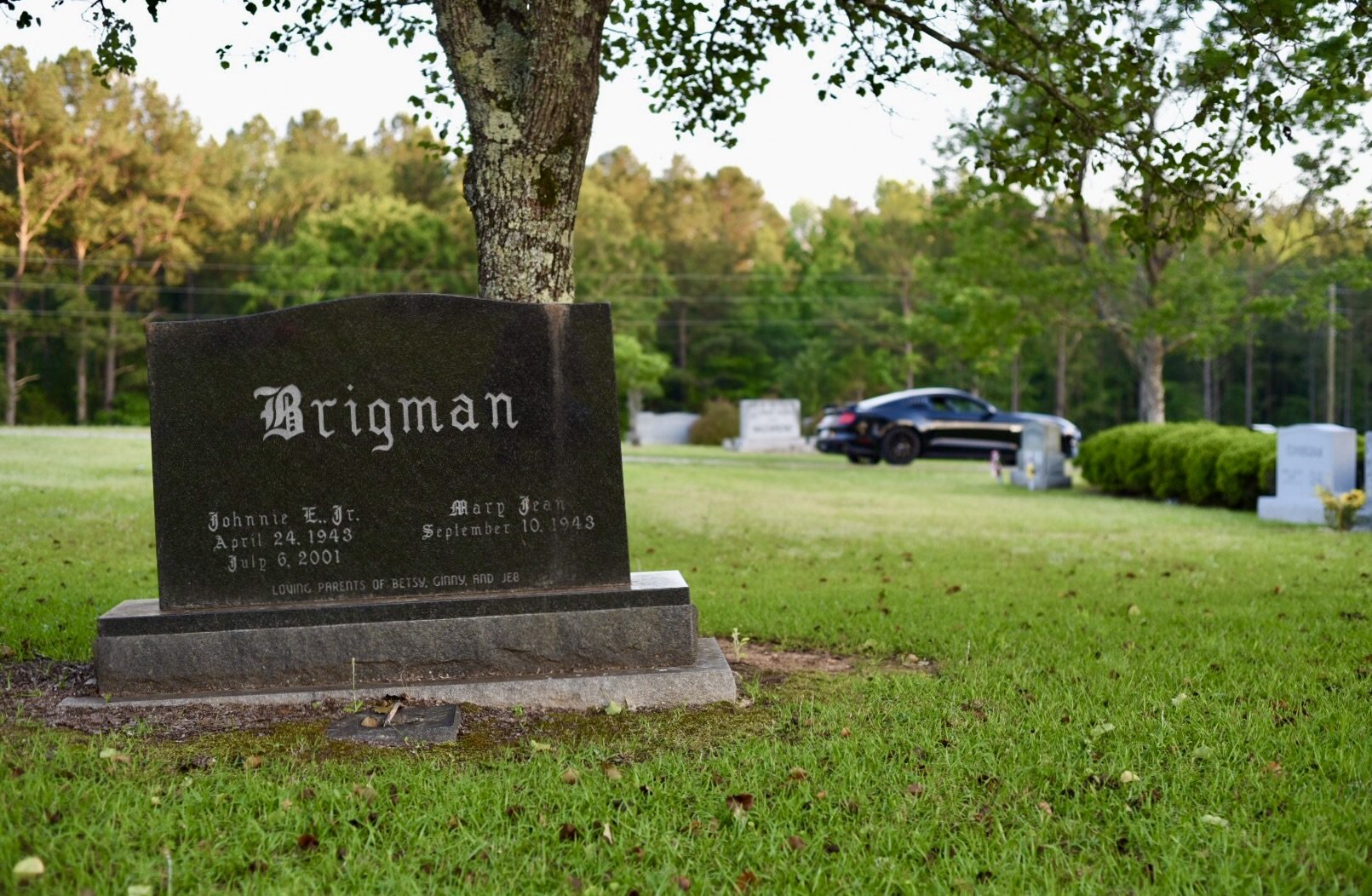
It has been almost twenty-five years, and I still marvel at what that man managed to do with one life. He loved deeply. He worked hard. He gave away so much of what he had. I wish I'd listened when he tried to teach me to cook. I wish I'd gone on more of the fishing trips. But I think that may be the particular curse of sons, to take our fathers for granted, to assume there will always be one more trip, right up until the morning there isn't.
So today I'm driving to Winnsboro, back to the Mill Hill, to the beginning that was also the end, to see my father. I'm driving a 2018 Mustang GT, and I want you to understand that this is not an accident either. I bought that car because of the stories my dad told me about his '65, the hitchhiking years, the U-Haul, the whole country unspooling out the windshield. Which means every mile on its odometer is a mile he inspired. He drove a Mustang away from home, as far as the map would let him. I drive one back to him. The boy who measured freedom in miles raised a son who measures love the same way.
And on the way I'll be thinking about the only thing I really know how to do with all of this, which is to try to pass it down. To be patient with Wyatt and Lolo. To teach them everything I can, or everything they'll hold still long enough to learn. To give generously. To love ferociously. To be even half the man my father was for me.
If I could say one thing to my own dad, it would be the simplest thing, and the truest:
Thank you for being the best dad you knew how to be.
I'll watch the sun go down for you tonight.